Midsommar Review
This movie is, in its entirety, strange. Not strange in the way a bad movie is strange, but strange in the way that makes you ask why humans are the way they are.
Talk about a rollercoaster of emotions? In retrospect this movie is an expression of what humans long for - community and power. The real credit goes to whoever’s idea it was to shoot it in Hungary and Sweden and make it visually so stunning. The story is captivating, confusing, and inspires everything in me to never go to a European commune, ever.
This movie is, in its entirety, strange. Not strange in the way a bad movie is strange, where you leave the theater wondering how someone received money to create it, but strange in the way that makes you ask why humans are the way they are. Why grief needs a home. Why isolation can make anything that looks like family feel like salvation. Why would people ignore every red flag imaginable if the grass is green enough and the flowers are arranged in a circle. The beginning of this movie is misery. Not cinematic misery either, but the type that makes you uncomfortable in your seat because it feels as though you have accidentally walked into someone’s life at their lowest possible point and are now expected to observe it silently. Florence Pugh, needless to say, carries this pain in a way that is both unbearable and mesmerizing. Her face alone acts more than some entire casts.
As someone who is limited in my understanding of Swedish cults, pagan traditions, emotional codependency, and whatever the hell Christian’s problem was, I was still completely taken into this world. The opening scenes establish Dani not as a protagonist you root for in the traditional sense, but as a human being drowning while everyone around her decides whether her grief is convenient enough to deal with. Christian is, from the beginning, a coward. Not a villain with grand plans or a man of evil genius, but somehow worse — a passive, weak, shoulder-shrugging boy who causes damage simply because he refuses to do anything with purpose. He is the kind of person who makes every room colder by being in it, not because he is always cruel, but because he is empty when fullness is required.
Then they go to Sweden. And goodness me.
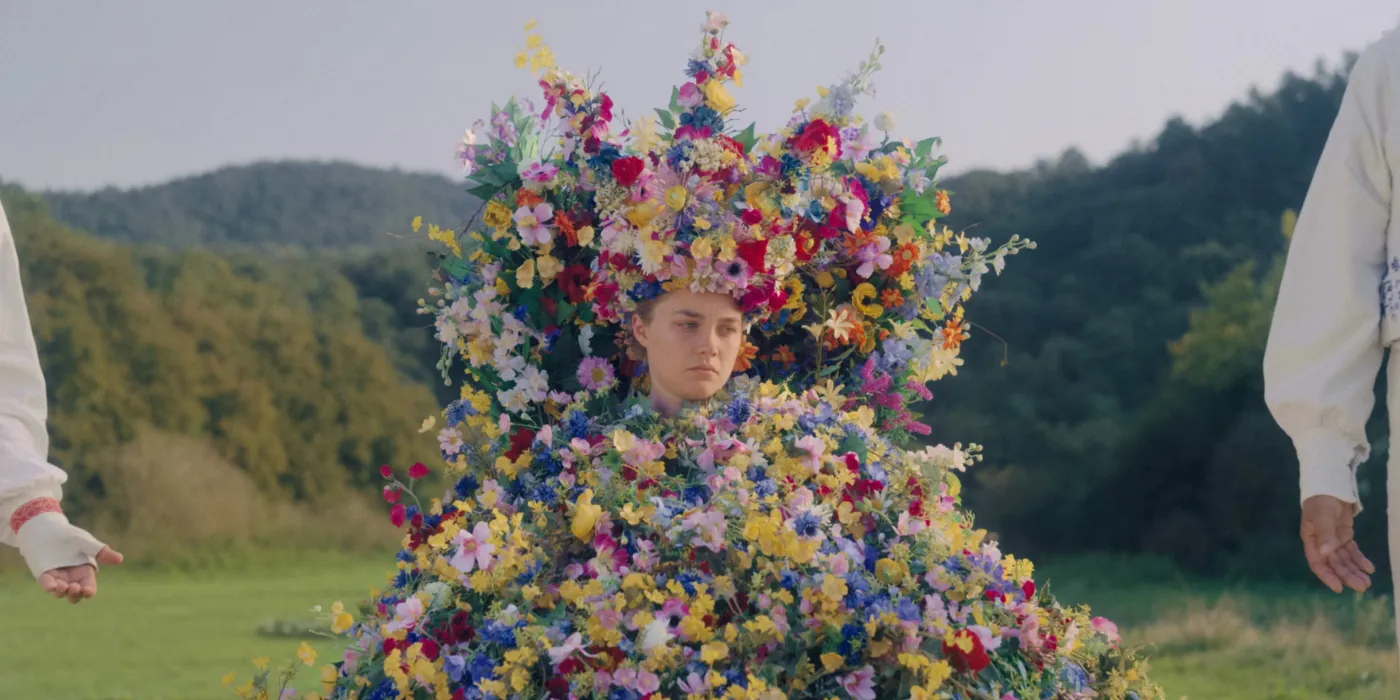
The sunlight and vibrancy in this movie is offensive. Horror is supposed to hide in shadows, under beds, in corners, in basements, in hallways with flickering lights. This movie says no, the horror will be in a field, under blue skies, surrounded by flowers, with people smiling politely and offering you tea that you absolutely should not drink. Every frame looks like a painting that wants to kill you. The costumes, the dinner tables, the houses, the murals, the flowers, the dancing, the insane dedication to symmetrical prettiness - all of it builds this world that feels both heavenly and deeply wrong. It is the rare movie where the beauty is not a break from the horror, but part of it. Maybe the main part of it.
The story itself is not complicated in the sense that you cannot follow it, but emotionally it is a maze. You are constantly asking yourself whether Dani is being destroyed or reborn. Whether this community is monstrous or simply honest about the monsters all humans quietly carry. Obviously they are monstrous. Let us not get carried away. They are killing people and acting like it is a scheduling matter. But the genius of the film is that by the end, amidst all the insanity, you almost understand why Dani smiles. Not because it is good, or moral, or sane, but because for the first time in the movie someone is feeling with her. Screaming with her. Holding her. Giving her a place to put the grief that everyone else treated like an inconvenience.
The supporting characters do exactly what they need to do, which is mostly make terrible decisions and represent the average tourist’s confidence in places they should have left three rituals ago. Will Poulter provides the humor, although even that humor feels like a man unknowingly dancing on the edge of a cliff. Friends are not written to be beloved, they are written to be disposable in a way that makes sense. You do not feel the movie begging you to mourn them, because quite frankly the movie has bigger things to worry about. Christian, again, is the emotional plague of this film. Jack Reynor does an excellent job making him pathetic without making him cartoonish. You can see every excuse forming in his head before he says it. It is impressive and infuriating, which is probably the point.
What this movie does best is atmosphere. Not jump scares, not monsters, not cheap suspense. Atmosphere. The feeling that something is wrong before anything technically is. The feeling that you are watching people smile with too many teeth. The feeling that tradition is just violence with better branding. Ari Aster seems to understand that the scariest thing in the world is not always death, but belonging to the wrong people at the exact moment you need belonging most.
What it misses, perhaps, is restraint. There are moments where the movie is so committed to being disturbing that it almost loses the emotional thread under the shock of it all. Certain scenes feel as though they exist to remind the audience that yes, this is still a horror movie, please do not get too comfortable looking at the flowers. But at the same time, I cannot say those scenes are unnecessary, because the excess is part of the experience. The movie is excessive in grief, excessive in sunlight, excessive in ritual, excessive in flowers, excessive in screams, excessive in everything. It overwhelms you because Dani is overwhelmed. It confuses you because she is confused. It traps you because she is trapped.
My favorite parts were the visuals, Florence Pugh’s performance, and the sheer audacity of making such a horrifying movie look like a summer vacation advertisement from hell. I cannot express how impressive it is to make daylight feel claustrophobic. To make a field feel like a prison. To make a flower crown feel like both a blessing and a death sentence.
If you go to movies for comfort, maybe do not. If you go to movies to feel normal afterward, absolutely do not. If you go to movies for stories about stable relationships, healthy coping mechanisms, and casual European travel, this is not the movie for you. But if you go to movies for emotion, discomfort, gorgeous cinematography, and the occasional reminder that humans will do anything to be held by a group that claims to understand them, then watch it.
Never joining a commune. Never drinking tea. Never following a friend to a remote Swedish festival.